Behold Your Mother/ Behold Your Son
Behold Your Mother/ Behold Your Son
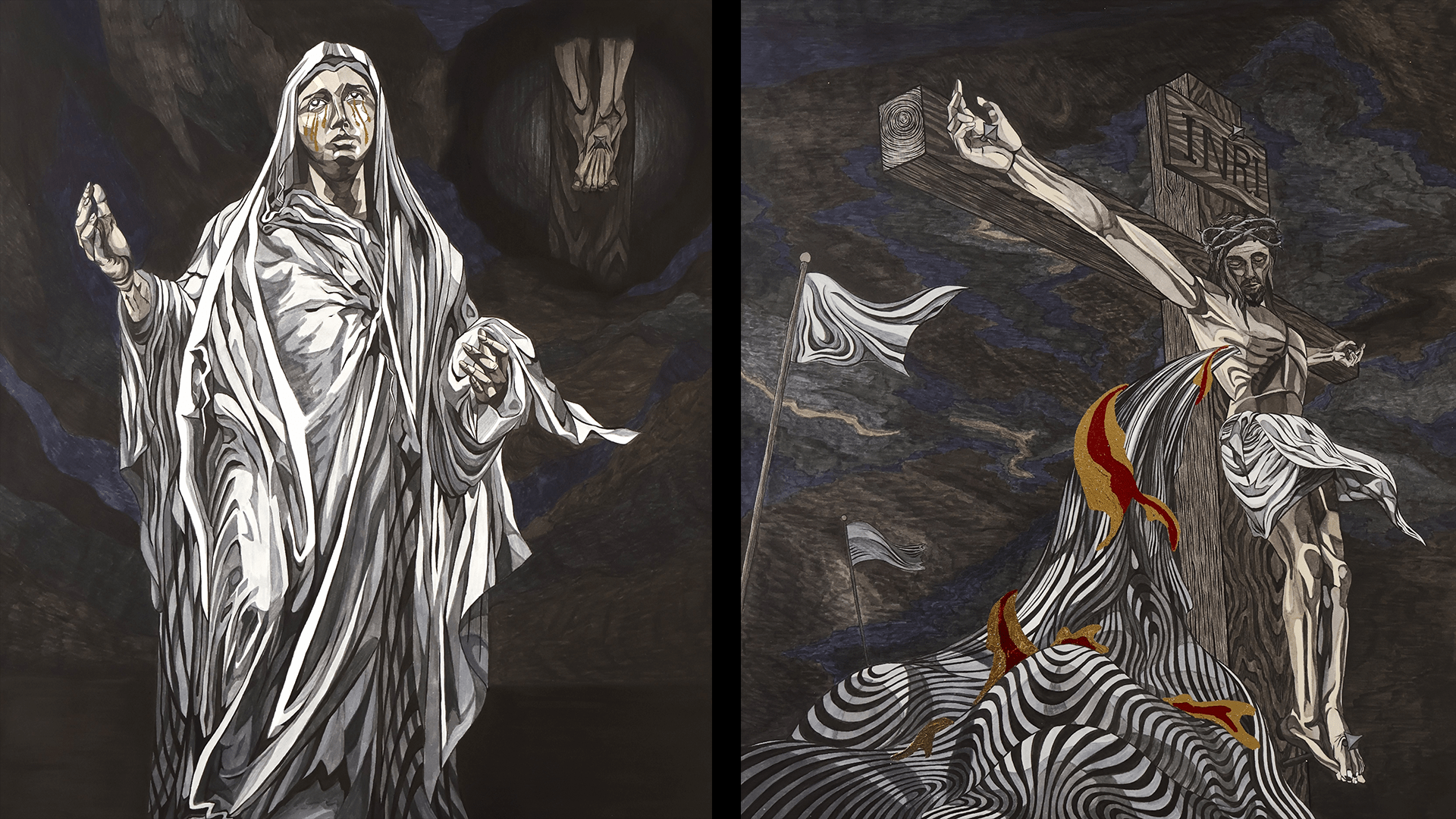
A Diptych inspired by the “Stabat Mater” by artist, Nathan Fan
Earliest depictions of the cross in Christianity come to us by way of a blasphemous graffiti mocking a certain “Alexamenos” for worshiping a distorted f igure, dying on the Cross. This piece of graffiti dates back to the year 200 A.D., amidst the era of Christian persecution by the Romans due to Christian practices and beliefs. Chief among these objections was the central claim of Christianity: a criminal cursed to die by crucifixion was divine.
Crucifixion was the image of the ultimate degradation — anyone doomed to die in such an odious way could only be hated by the divine powers. Even the Christians of that era, who typically gloried in their victorious martyrdoms, eschewed portrayals of Christ on the cross. Prior to the tradition of the crucifix in art, artistic images were almost exclusively meant to commemorate the victorious dead and their moments of triumph or to worship and appease their various gods. With art, one could make something that could outlive one’s short lifespan or one’s even shorter memory. Everything shameful, hideous, and deplorable about man was only ever meant to be the subject of snide graffiti.
But the strangeness of the Christian art tradition emerged like a revolution from an even stranger, even more revolutionary declaration of faith, made by the Apostle Paul in his letter to the Galatians: “But far be it from me to boast except in the cross of our Lord Jesus Christ, by which the world has been crucified to me, and I to the world.”
In the San Marco Abbey in Florence, Italy, there are 43 cells, each with a masterful fresco painting by Fra Angelico. What really stands out in these frescoes, particularly the crucifixion scenes, is the striking emphasis on the blood of Christ; in some scenes it is running down his arms and legs and dripping onto the ground below, sometimes even forming a pool. The emphasis on blood is notably graphic for depictions of the Crucifixion, and researchers have concluded that these particularly bloody images of the crucifixion were painted to offer peace and comfort to the abbey’s novices, young men of about 19-year-old, preparing for their first sessions in the Medieval medical practice of blood-letting.
As I stood under these magnificent frescos, I was struck by how many generations of young men would stare up at these depictions of the crucifixion, not for studying the gracefulness of the brush stroke or the rendering of the anatomical forms or augmenting their vacation in the city of Florence; they looked to these images out of desperation for comfort. Fear over the blood-letting process was well-documented among these young novices, and with these frescos being painted in their own private rooms, Fra Angelico had given them a gift: these images of Christ crucified were to give them courage amidst their fear – a reminder of how Christ shared in their sorrow.
While the young men of this Florentine Dominican monastery looked to Christ through the blood of His cross, another abbey of Dominican sisters in Bologna looked to Christ through the sorrows of His mother. About a century before Fra Angelico, we have the earliest record of the Stabat Mater poem. What makes this poem so striking is its ability to see the sorrowful Mary standing beneath the cross, and then turn to see what she is weeping over: the body of her Son. The poet realizes that no one could possibly love her son more than her, watching Jesus die for the sins of the world, and it inspires a powerful prayer: a plea to gain the ability to weep with her — to stay by Mary’s side until the last drop her son’s blood is poured out for mercy on the world.
Whenever I hear this poem, I am caught by the realization that there’s always more love to show for Christ: by looking to His Mother who loved him best. The Virgin Mary becomes an icon of how to love Christ when he was at His most forsaken, and the poem gives us a chance through the imagination to participate in her sorrow and in her love. Where Christ on the cross shows God’s great love for us poured out for us, the Virgin Mary shows that God’s love for us is so great that it will transform us into the people who can begin to love God back.
It is remarkable to discover these places where theology and art intersect – both disciplines aim to address the transcendent aspect of our reality, one through the mind and the other through the body. By applying our minds to thinking of the deep things of God revealed by Grace and applying our eyes and ears (for artists, the hands) to beholding the presence of God effusive in Nature, the Christian tradition has discovered a special meeting place between mankind and the divine – the place where worship happens. Discovering this intersection point is obeying the inclinations of how God created us, further revealing that it is God who wants to be found — the God who has made Himself knowable to us in our own meager means – because He is so insistent on sharing His divine life with us, His beloved.
In making this art piece, I got to study a rich and full tradition of depicting Jesus’ death by crucifixion, and it is strange to consider how this image, once considered so deplorable, has since beckoned so many artists from across every discipline to contemplate it. These artists, in turn, have endeavored to beckon their viewers and their listeners to do the same. If art has any power at all, its power must lay in its ability to arrest our attention and draw us into a perspective of reality that matters. No matter how many composers seek to make a new Stabat Mater, no matter how many artists seek to paint another crucifixion, the depth of the tradition reveals there is always more to contemplate here. Although this diptych is made in 2026 and Kim Arnesen’s music just a few years before that, they are both additions to a tradition that is meant to testify to an eternal pronouncement of grace that must be attended to.
This is why Christ was lifted up on a cross – just like Moses’ own work of art in making a bronze serpent – so that the people could look up and see the reality of God’s love. This is why Christ was born of a Virgin – a woman who treasured each moment of her Motherhood ever since her moment of surrender to God’s will – so that those who saw her weeping for her Son could know how God who weeps for them, yearns for them to rejoin the embrace. In truth, portraying the cross is not counter-cultural at all. It is still a depiction of the greatest victory won by the God who became f lesh: that while we were still sinners, God showed His love by being born of a woman and suffering death for our salvation and for the whole world.
 Nathan Fan is an artist who works mostly with ink, paper, and gold leaf to depict stories that inspire the imagination, particularly in the themes of faith, theology, and the invisible world. He studied art at Biola University and began his practice in ink drawings while studying theology in graduate school. He also works as a Theology teacher and Art teacher at the Covenant School. His approach to art involves blending the elements of storytelling, academic research, devotional hagiography, theology, art history, and philosophy of aesthetics.